
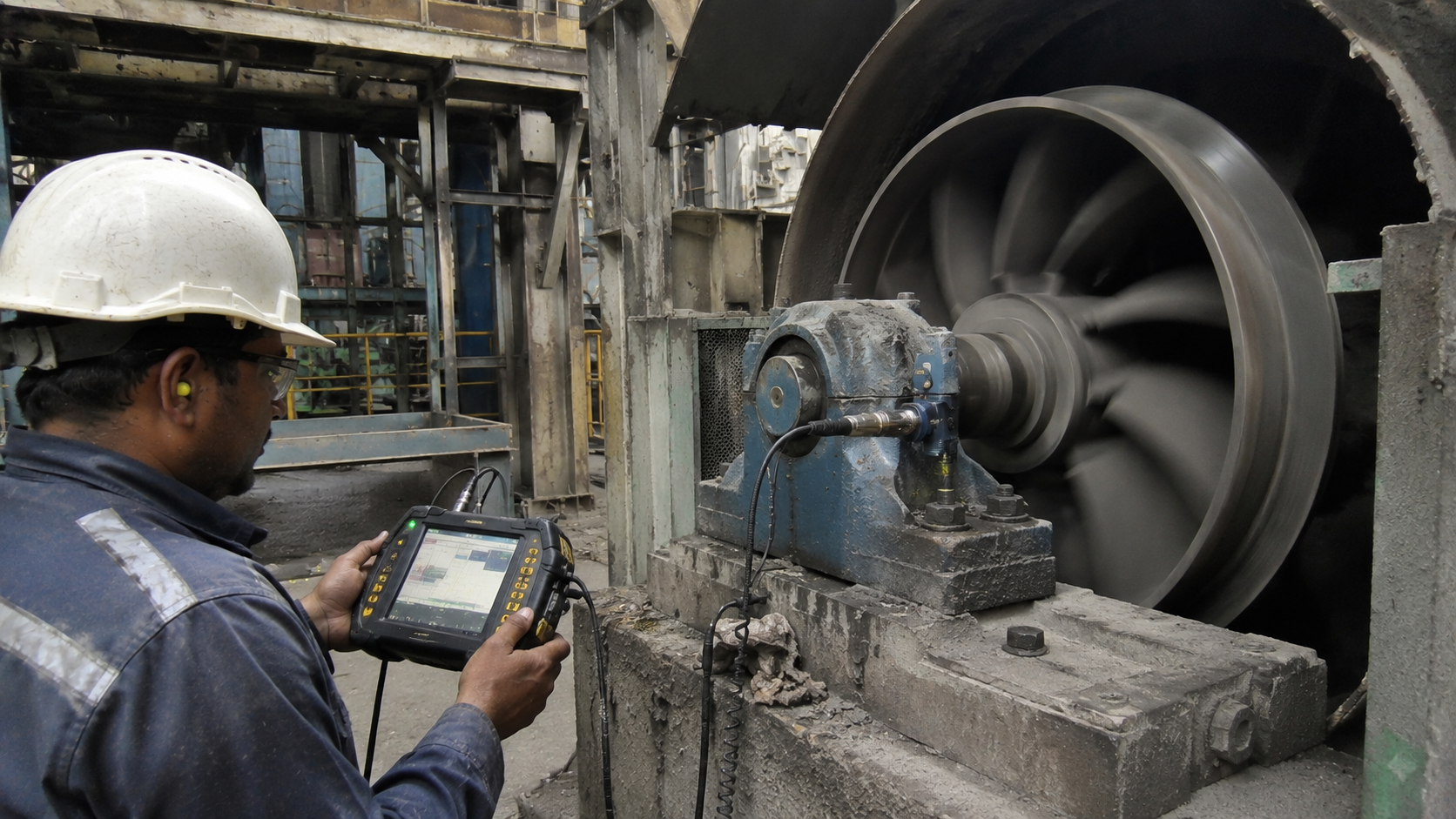
On-Site / In-Situ Balancing
Dynamics Engineering provides on-site dynamic and static balancing for rotating machinery — fans, blowers, rotors, impellers, and drive components — eliminating the need to remove equipment from its operating position. In-situ balancing corrects residual imbalance in the actual running condition, accounting for real mounting effects that bench balancing cannot replicate.
Vibration and imbalance cause bearing failure, structural fatigue, and energy loss. Our field balancing service identifies imbalance, calculates correction weights, and verifies the result — all without production-disrupting dismantling.
On-Site Balancing Services
- Single-plane and two-plane dynamic field balancing
- Fan and blower in-situ balancing
- Induced draft and forced draft fan balancing
- Pump impeller balancing
- Rotor and armature field balancing
- Vibration analysis and diagnosis
- Trim balancing after workshop overhaul
- Post-repair balance verification
Balance It Where It Runs.
Workshop balancing on a balancing machine cannot account for rotor bow from operating temperature, structural resonances of the mounting, or mass additions like blade erosion deposits. In-situ balancing corrects imbalance in the actual installed condition.
The result: lower vibration levels, longer bearing life, reduced structural stress, and better energy efficiency — achieved without removing the rotor from service.
- Certified vibration analysts on every job
- Advanced portable vibration analyser and balancing instruments
- Balancing to ISO 1940-1 Grade G1 and better
- Documented balance report with before and after vibration readings
- Experience on fans, blowers, pumps, and rotating machinery in all industries
How In-Situ Balancing Works
Baseline vibration recorded at bearings; phase and amplitude data captured at running speed.
Known trial weight attached; machine run again to determine influence coefficients.
Software calculates optimum correction weight mass and angular position for each plane.
Correction weight fitted; final run confirms vibration reduction; balance report issued.
What is in-situ balancing?
In-situ or field balancing corrects imbalance in a rotating component while it remains installed in its operating position, using vibration measurements and trial weights to calculate and apply correction masses.
How do you know the rotor is balanced?
We measure vibration amplitude and phase at the bearings before and after correction. Final vibration levels are documented in a balance report and compared against ISO 1940-1 acceptance criteria.
What equipment do you balance on-site?
ID fans, FD fans, PA fans, centrifugal blowers, pump impellers, rotors, and other rotating components up to large industrial machines.
Experiencing high vibration? Contact Dynamics Engineering for on-site balancing and vibration diagnosis.
Request Balancing Service