What On-Site Shaft Machining Actually Involves
A shaft doesn't wear evenly. The bearing seats take the radial load, the coupling face takes the thrust, and the keyway takes the torque — so after enough running hours, you rarely get a shaft that's "worn" in one simple sense. You get a shaft that's slightly out of round in one spot, a keyway that's opened up by a few thousandths, and a coupling face that's no longer flat enough to seat properly. None of that shows up until vibration readings start climbing or a bearing fails earlier than it should.
The traditional fix is to pull the shaft, send it to a machine shop, and wait. For a shaft that's coupled to a turbine, a large pump, or a rolling mill drive, that's not a same-day job — it's a crane booking, a transport window, a queue at the shop, and then the reverse trip back. Two or three weeks of a line down is a realistic estimate, and that's before anything goes wrong with the logistics.
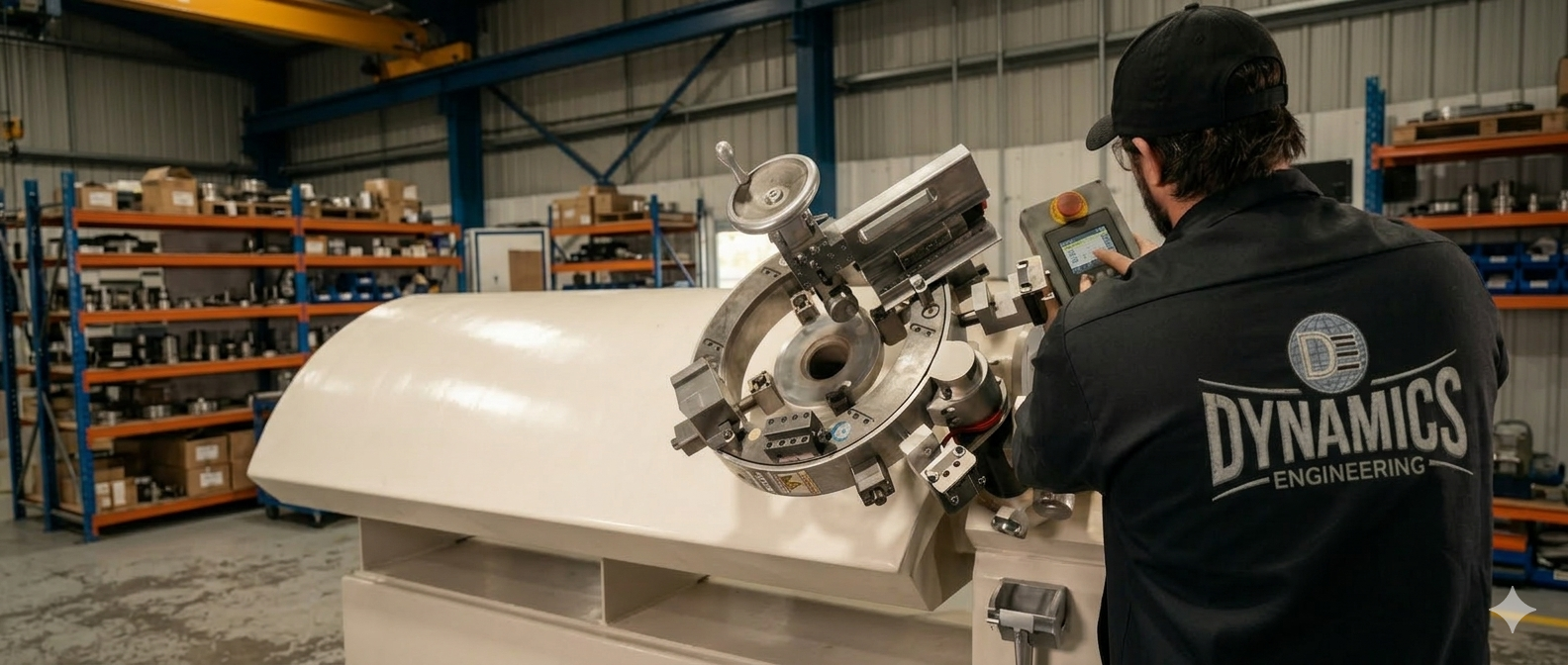
On-site shaft machining and in-situ shaft machining skip that entirely. We bring portable, precision machining equipment to wherever the shaft is installed — turbine hall, pump station, mill floor — and machine it in place. The shaft never leaves its bearings, the coupling stays roughly where it was, and in most cases the surrounding equipment doesn't need to come apart at all.
What We Machine, and to What Tolerance
Shaft machining covers a narrower set of operations than the name suggests — it's really about restoring a handful of critical surfaces to the tolerance the original design called for. In practice, that's usually one or more of the following:
- Bearing seats and journals — restoring roundness and diameter after wear, corrosion, or fretting, so the bearing seats correctly and load is distributed the way it was designed to be.
- Coupling faces — re-facing to correct flatness and perpendicularity, so the coupling doesn't introduce its own misalignment on reassembly.
- Keyways — re-cutting or oversizing a worn keyway so the key fits without the play that causes fretting and eventual failure.
- Threaded and shouldered sections — cleaning up damaged threads or step diameters where a nut, sleeve, or impeller locates.
We work across carbon steel, stainless, and most alloy shaft materials, on diameters from a few centimetres up to large mill and turbine shafts, holding tolerances in line with the original OEM drawing wherever one is available. Where it isn't, we take our own dimensional survey first and machine to what the mating components actually require — not a guess.
Why Plants Choose In-Situ Over Sending the Shaft Out
The honest answer is downtime, not cost. A workshop can often do the machining itself just as well as we can on site — the difference is everything around it. Uncoupling, rigging, transport, and reinstallation each carry their own schedule risk, and each one is a chance for something to go wrong that has nothing to do with the machining itself.
Doing it in place also avoids reintroducing alignment error. Once a shaft comes out of its bearings, you lose the reference it had to the rest of the train, and realigning everything on reassembly is its own job, with its own margin for error. Machining in-situ means the shaft's relationship to the rest of the equipment barely changes.
Where This Matters Most
In-situ machining earns its keep fastest on equipment that's expensive or slow to remove — where every day of shutdown has a direct cost attached to it:
- Turbine and generator shafts
- Mill drive shafts
- Compressor trains
- Marine propulsion shafts
Our Process for On-Site & In-Situ Shaft Machining
Every job starts with measurement, not machining. The sequence below is the same one we follow whether it's a routine bearing seat repair or a shaft that's been flagged during a shutdown inspection.
Site Assessment
We inspect the shaft in place, measure the actual wear or damage, and confirm what tolerance the job needs to hit.
Machining Plan
Based on that data, we plan the equipment setup, cutting sequence, and target dimensions before anything is mounted.
On-Site Machining
Portable machining rigs are mounted and aligned to the shaft, and material is removed in controlled, measured passes.
Verification & Report
Final measurements confirm the surface is within tolerance, and we hand over an inspection report for your records.
Industries We Serve
Shaft machining shows up in most heavy industries eventually, but the majority of our on-site and in-situ machining call-outs come from a handful of sectors where large rotating equipment runs continuously:
Shaft Machining: Common Questions
Is on-site shaft machining as accurate as workshop machining?
Yes, when it's set up correctly. Portable machining rigs use the same measurement principles as a lathe or grinder — the difference is that the tool is aligned to the shaft rather than the shaft being loaded into the tool. With proper setup and in-process measurement, we hold the same tolerances a workshop would.
How long does an in-situ shaft machining job usually take?
It depends on the diameter, the amount of material to remove, and access at the site, but most single-shaft jobs run from one to a few days on site, plus setup and measurement time — considerably less than the transport and workshop queue time a traditional repair involves.
Do you need to fully dismantle the equipment to machine the shaft?
Usually not. In most cases we work around the shaft in its installed position, with only the immediate area — coupling guard, bearing cap, or similar — opened up for access. Full disassembly is the exception, not the rule.
Can you match an OEM drawing if we don't have one anymore?
Yes. Where original drawings aren't available, we take a full dimensional survey of the shaft and the mating components first, and machine to what those components actually require rather than an assumed spec.
What shaft sizes and materials can you work with?
We work across carbon steel, stainless, and most common alloy shaft materials, from small pump shafts up to large turbine and mill drive shafts. If you're unsure whether a specific shaft is within scope, the fastest way to find out is to send us the diameter and application and we'll confirm.
Dynamics Engineering provides on-site shaft machining, in-situ shaft repair, and portable field machining services for plants across Pune, Maharashtra, and PAN India. If your shaft, bearing seat, or coupling face needs precision on-site machining without a shutdown for transport, get in touch for a site assessment.
Get a Quote for Shaft Machining