What On-Site Milling Actually Involves
Milling is one of those jobs that sounds simple until you're the one trying to move a machine bed or a foundation plate to a workshop mill. A lot of the flat surfaces that need machining, mounting pads, gearbox faces, base plates, are bolted into or cast onto something far too large to lift out and transport. Once those surfaces lose flatness from corrosion, impact damage, or years of vibration, you're stuck with a repair that a fixed shop mill simply can't reach.
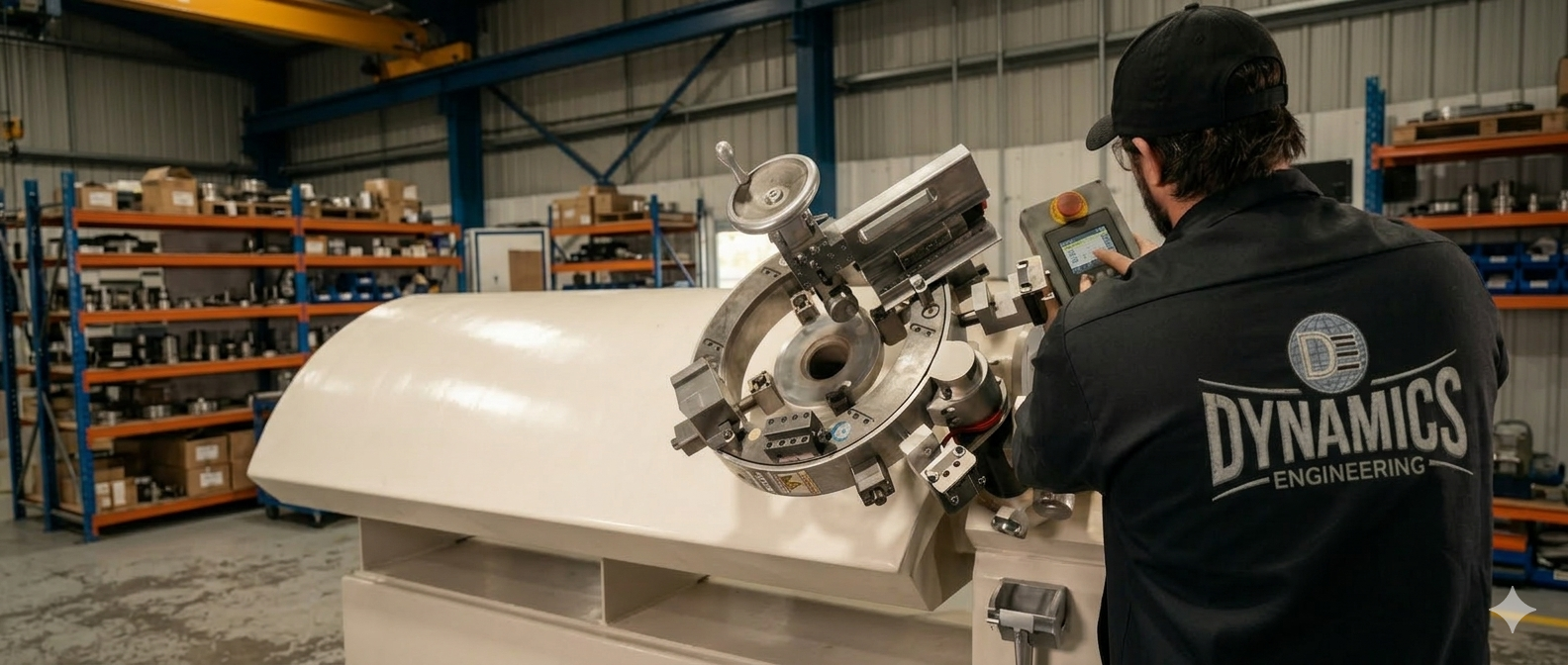
On-site milling solves that by bringing the mill to the surface instead. A portable milling unit is clamped or magnetically mounted directly to the equipment, and the surface is cut flat and to spec exactly where it sits. It works whether the job is a base pad that's lost flatness, a gasket surface that needs a fresh cut, or a repair weld that needs to be machined down to the correct profile.
In-situ milling isn't a lower-accuracy version of shop milling. With the right setup and alignment, it holds the same flatness and finish tolerances a fixed mill would, because the cutting head is referenced to the surface itself rather than to a machine table.
What We Mill, and to What Tolerance
Most on-site milling work falls into a few recurring categories:
- Machine base pads. Restoring flatness on motor and compressor mounting surfaces so alignment holds under load.
- Gasket and seal faces. Re-cutting a surface that's pitted or scored so it seals properly again.
- Weld repair machining. Machining a built-up weld repair down to the correct profile and finish.
- Structural surfaces. Milling flats, slots, or pockets on large fabricated or cast components that can't be moved.
We hold flatness tolerances in line with the original equipment specification wherever one exists, and where it doesn't, we take our own measurements against the mating component and machine to what that component actually needs.
Why Plants Choose On-Site Milling Over a Workshop Repair
For most of the surfaces we mill, the honest problem isn't whether a shop could do the work. It's that the part in question is bolted to a foundation, cast into a base frame, or simply too heavy to move without a major rigging effort. Sending it out isn't a small logistics step, it's a project of its own.
Milling in place also protects the alignment that already exists around the surface. Once a base plate or housing is unbolted and moved, you're relying on reinstallation to get everything back where it was. Working on it in situ means that relationship never has to be disturbed in the first place.
Where This Matters Most
On-site milling earns its keep fastest where removal simply isn't practical:
- Compressor and motor base pads
- Pump and gearbox mounting faces
- Large fabricated structural components
- Vessel and tank flange surfaces
Our Process for On-Site Milling
Every milling job starts with a proper survey of the surface. That's what tells us how much material needs to come off and where the high and low points actually are.
Site Assessment
We inspect the surface, measure flatness deviation, and confirm the tolerance the job needs to meet.
Machining Plan
Based on that survey, we plan the mill setup, mounting method, and cutting sequence for the surface.
On-Site Milling
The portable mill is mounted and aligned directly to the surface, and material is removed in controlled passes.
Verification and Report
Final measurements confirm flatness and finish, and we hand over an inspection report for your records.
Industries We Serve
On-site milling calls usually come from plants where the equipment or structure being repaired simply can't be moved to a workshop without major cost or downtime:
On-Site Milling: Common Questions
Is on-site milling as accurate as a fixed workshop mill?
Yes, when the equipment is set up and aligned correctly. The mill is referenced directly to the surface being cut, and with in-process measurement, it holds the same flatness and finish tolerances a shop mill would.
Do you need to remove the equipment or take it apart first?
Usually not. In most cases the mill is mounted directly onto or around the surface, with only local access needed. Full disassembly is rare and only comes up if something is blocking the surface entirely.
How much material can you remove in an on-site job?
That depends on the surface and equipment involved. For minor flatness correction it can be a light skim, and for weld repair machining it can be a heavier cut down to the correct profile. We assess this during the site survey.
Can you match a specific surface finish for gaskets or seals?
Yes. We machine to the finish the gasket or seal type actually requires, whether that's a smooth face or a specific pattern for a particular gasket design.
What size surfaces or components can you work on?
From small mounting faces up to large fabricated structures and foundation plates. Send us the surface size and application and we'll confirm scope.
Dynamics Engineering provides on-site milling, in-situ surface machining, and portable field machining services for plants across Pune, Maharashtra, and PAN India. If a surface on your equipment needs flattening or repair without removal, get in touch for a site assessment.
Quote for On-Site Milling