
What Ring Orbital Machining Actually Involves
Slip rings and collector rings are largely the same component under two different names. Motors and generators tend to call them slip rings, while wind turbines and some large generator designs call them collector rings, but both are doing the same job, carrying current across a rotating contact. Both wear the same way too, and both can be corrected using orbital machining.
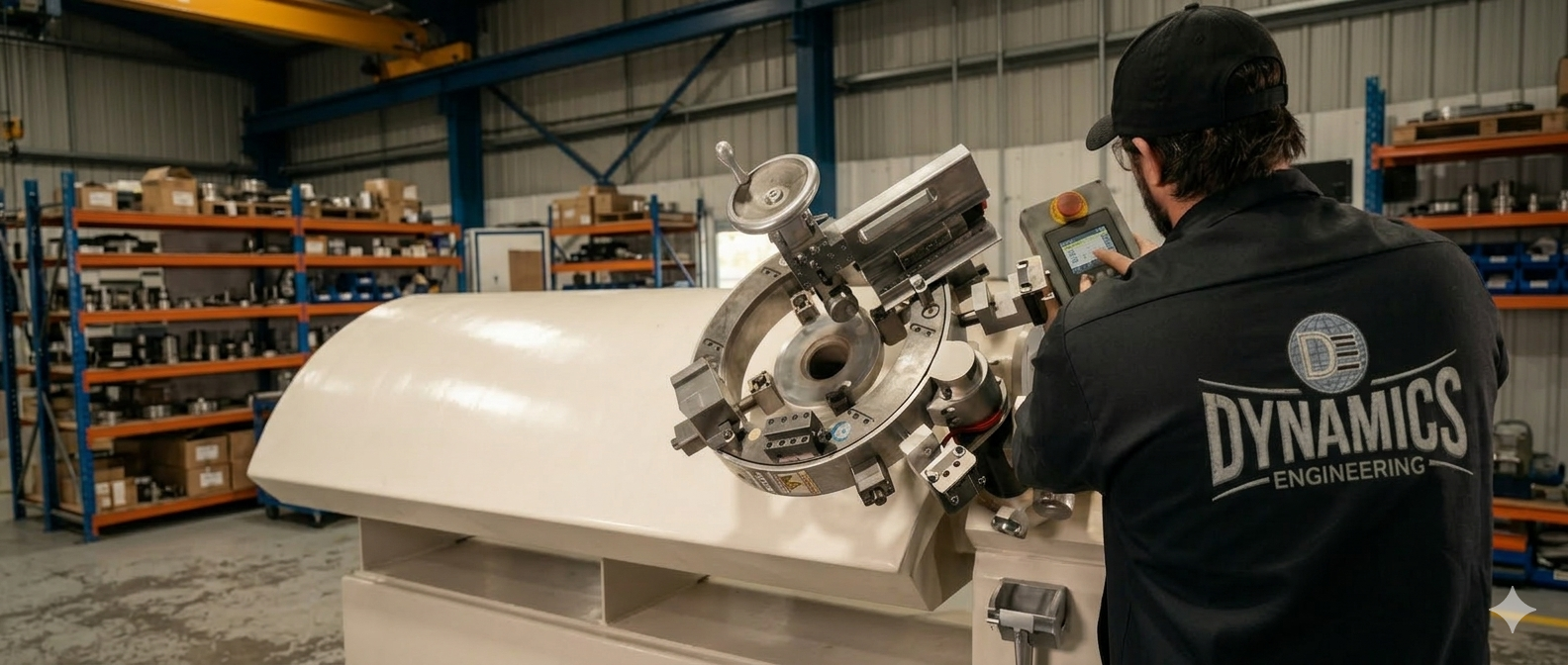
Orbital machining works differently from conventional turning. Instead of the ring rotating against a fixed cutting tool, the tool itself orbits around the stationary or slow-turning ring, cutting the surface true without requiring the rotor to be spun at machining speed. This matters because some generator and turbine configurations make it difficult or risky to run the rotor at the speed conventional turning would need, and orbital machining avoids that requirement entirely.
The result is the same as any ring correction, a round, true, properly finished contact surface, but reached through a method suited to installations where the ring can't easily be spun against a fixed tool.
What We Machine, and to What Tolerance
Ring orbital machining covers the same range of ring problems as conventional turning, applied through the orbital method:
- Out-of-round correction. Restoring roundness on slip or collector rings without spinning the rotor at machining speed.
- Grooved or scored surfaces. Cutting back damage from brush wear or arcing to a smooth, uniform diameter.
- Wind turbine collector rings. Machining rings in nacelle-mounted generators where access and rotor handling are limited.
- Large generator slip rings. Correcting rings on rotors where conventional turning setups aren't practical.
We work to the tolerance the brush gear and contact requirements call for, whether that's a generator in a power plant or a collector ring assembly inside a wind turbine nacelle.
Why Orbital Machining Suits Installations Conventional Turning Can't Reach
Conventional slip ring turning needs the rotor to spin at a controlled speed against a fixed tool, which is straightforward in some installations and genuinely difficult in others. A wind turbine collector ring, mounted inside a nacelle with limited access and no easy way to safely spin the rotor at the required speed, is a good example of where that approach runs into real limits.
Orbital machining removes that constraint by moving the tool instead of the rotor. That opens up ring correction on equipment where a conventional setup would be impractical or unsafe to arrange.
Where This Matters Most
Orbital machining earns its keep fastest where rotor spin during machining is difficult or restricted:
- Wind turbine nacelle-mounted generators
- Large power plant turbogenerators
- Restricted-access rotor installations
- Rings where high-speed spin carries risk
Our Process for Ring Orbital Machining
Orbital setups need precise alignment between the tool path and the ring, since the tool is doing the moving rather than the rotor.
Site Assessment
We inspect the ring condition, confirm access constraints, and assess whether orbital machining is the right approach.
Machining Plan
We plan the orbital tool path, mounting method, and target diameter based on the ring's actual condition.
On-Site Machining
The orbital head is mounted around the ring, and the surface is cut true in controlled passes as the tool orbits.
Verification and Report
Final measurements confirm roundness and finish, with an inspection report for your records.
Industries We Serve
Ring orbital machining requests come mainly from operators of large generators and wind turbines, where the rotor or nacelle configuration makes conventional turning impractical:
Ring Orbital Machining: Common Questions
What's the actual difference between slip rings and collector rings?
Functionally, they're the same component, a rotating contact surface that carries current to or from a rotor. The naming difference is mostly industry convention, with wind turbines and some large generators using "collector ring" and motors and generators more often using "slip ring."
Why use orbital machining instead of conventional turning?
Orbital machining doesn't require the rotor to spin at machining speed, which makes it suitable for installations, like nacelle-mounted wind turbine generators, where spinning the rotor for conventional turning is impractical or unsafe.
Can orbital machining achieve the same tolerance as conventional turning?
Yes, with a properly set up tool path and in-process measurement, orbital machining holds the same roundness and finish tolerances conventional turning would achieve.
Do you work inside wind turbine nacelles?
Yes, nacelle access work is a regular part of this service, and we plan equipment setup around the space and access constraints typical of that environment.
How do I know if my installation needs orbital machining versus conventional turning?
It comes down to whether the rotor can be safely and practically spun at machining speed. We assess this during the site visit and recommend the method suited to your specific equipment.
Dynamics Engineering provides on-site ring orbital machining for slip rings and collector rings, along with portable field machining services for power and wind operators across Pune, Maharashtra, and PAN India. If your rotor or nacelle configuration makes conventional turning impractical, get in touch for a site assessment.
Quote for Ring Orbital Machining