
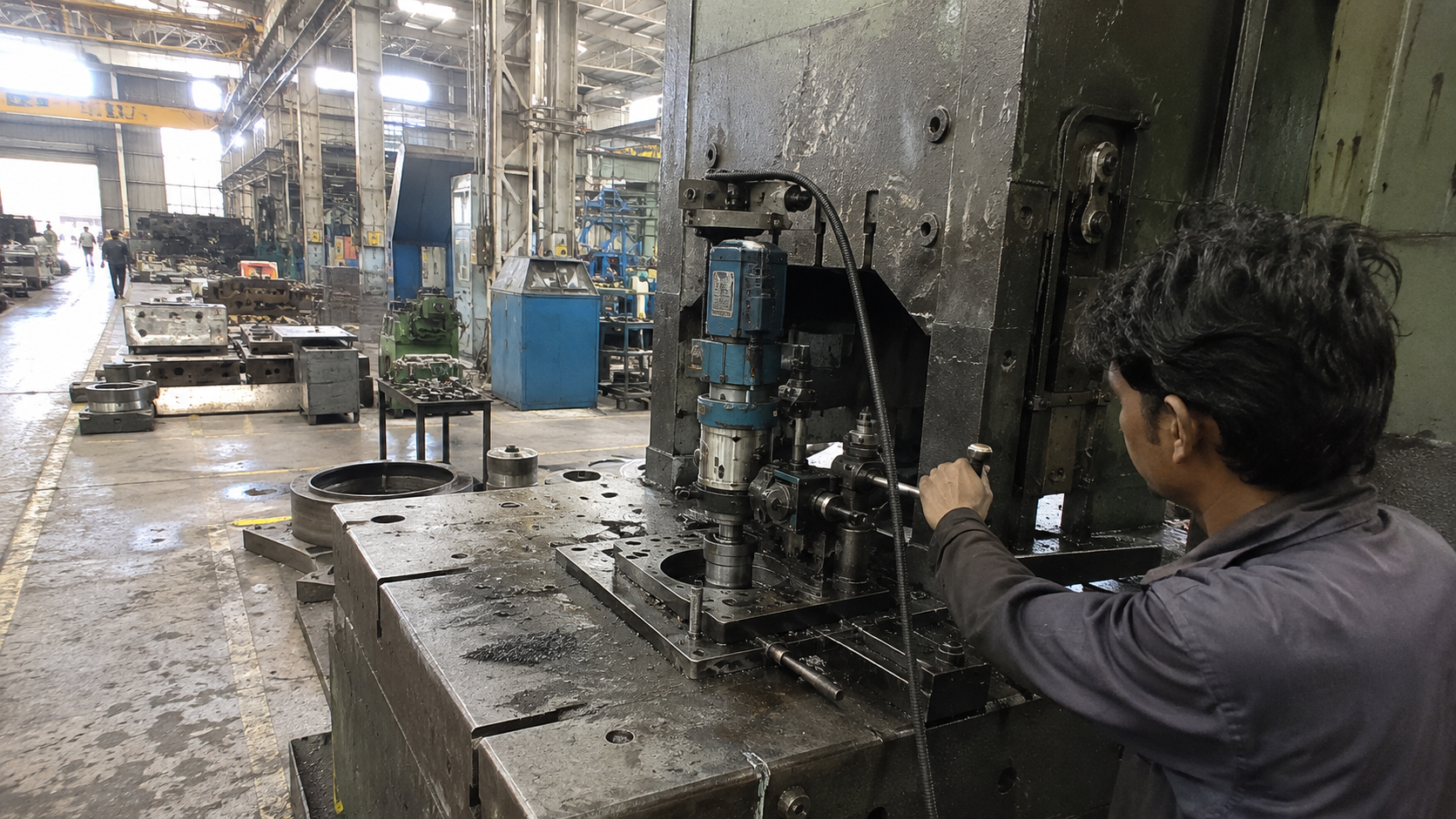
Press Bed Machining at a Glance
Industry
Steel & Heavy Manufacturing
Location
Shimla
Service
On-Site Milling
Duration
11 Days
A Forging Press Bed Out of Flat
Years of high-tonnage impact loading had left the bed of a forging press worn out of flat, with localized low spots where repeated die strikes had gradually deformed the surface. The die set could no longer seat evenly across the bed, and the plant was starting to see it show up as inconsistent part quality coming off the press.
A press bed this size isn’t something that comes off the machine for a workshop resurfacing job without a major rigging and crane operation, and the press itself would need to be out of production for the full duration of that removal and return. For a plant running the press on a tight production schedule, that kind of shutdown was the real obstacle, not the machining itself.
Die Seating Risk
A bed that’s no longer flat means the die set can’t seat evenly across its full contact area, which shows up directly as inconsistent part quality.
Removal Isn’t Practical
A press bed of this size and weight isn’t something that can be pulled and shipped for resurfacing without a major, costly rigging operation.
Production Downtime
Every day the press is out of service for a bed repair is a day of lost production capacity that the plant has to plan around.
Progressive Damage
Left uncorrected, continued impact loading on an already low spot tends to deepen the deformation over time, rather than stay static.
✓ No Press Disassembly
✓ Flatness Restored to Spec
✓ Die Seating Corrected
✓ Minimal Production Downtime
Milling the Bed Flat Without Moving the Press
Our team surveyed the full bed surface first, mapping the low spots and overall deviation with laser measurement so the machining plan was based on where material actually needed to come off, rather than a uniform skim across the whole bed.
A portable milling unit was mounted directly onto the bed structure itself, and the surface was machined flat in controlled passes. The press frame and drive stayed fully assembled throughout, with only the bed surface being worked on.
Full-Surface Survey
Laser measurement mapped deviation across the entire bed before machining, identifying exactly where the low spots were.
Mounted Directly on the Bed
The milling unit was set up on the bed itself, so there was no need to move or partially disassemble the press to reach the surface.
Controlled Material Removal
Passes were planned to bring the low spots up to a consistent plane without removing more material than necessary elsewhere on the bed.
In-Process Checks
Flatness was verified between passes, tracking progress toward the target tolerance rather than relying on a single final measurement.
Step-by-Step: On-Site Milling for Press Bed Restoration
The same four-stage process we follow on any on-site milling job was used here, scaled to the size of a forging press bed.
Site Assessment
Surveyed the full bed surface and measured flatness deviation to identify the extent and location of the low spots.
Machining Plan
Planned the mill setup and cutting sequence based on the measured survey, targeting the correction the bed actually needed.
On-Site Milling
Machined the bed surface flat in controlled passes, with the press frame and drive left fully assembled.
Verification
Re-measured the full bed to confirm flatness was within tolerance before the press was returned to production.
Bed Restored, Die Seating Corrected
The press bed was restored to the flatness tolerance the die set required, correcting the uneven seating that had been showing up as inconsistent part quality. The die now contacts the full bed surface evenly, the way the press was designed to run.
Because the work was carried out with the press fully assembled and in place, the plant avoided the rigging, transport, and reinstallation a conventional bed removal would have required, and production downtime was limited to the machining window itself.
What This Prevented
- Continued inconsistent part quality
- Progressive deepening of the low spots
- The cost and downtime of a full press bed removal
- Unplanned production stoppages from the underlying issue
Equipment & Techniques Involved
On-Site Milling
Laser Flatness Survey
Die Seating Correction
Heavy Structural Machining
Common Questions
How do you machine a bed this large without a fixed mill?
Portable milling equipment is mounted and referenced directly on the bed itself, cutting the surface true relative to the bed rather than requiring the workpiece to be loaded onto a stationary machine.
Does the press need to be shut down for the full repair?
Yes, the press needs to be out of production for the machining window, but that window is significantly shorter than the time a full bed removal and workshop resurfacing would take.
Can you correct a bed with deep, localized damage, or only general wear?
Both, within limits. Localized low spots are corrected by machining the surrounding area down to match, and general wear is corrected with an overall skim. Severe, deep damage may need a different repair approach, which we’d assess on site.
What press sizes have you worked on?
From mid-size stamping presses up to large forging presses. Send us the press tonnage and bed dimensions and we will confirm scope.
Explore the Service Behind This Project
On-Site Milling
Restoring flat surfaces, mounting pads, and press beds on equipment that can’t practically be removed for workshop repair.
Seeing Inconsistent Die Seating on Your Press?
If your press bed has developed low spots or uneven wear, our engineers can assess whether it’s a candidate for on-site milling before you consider a full removal.